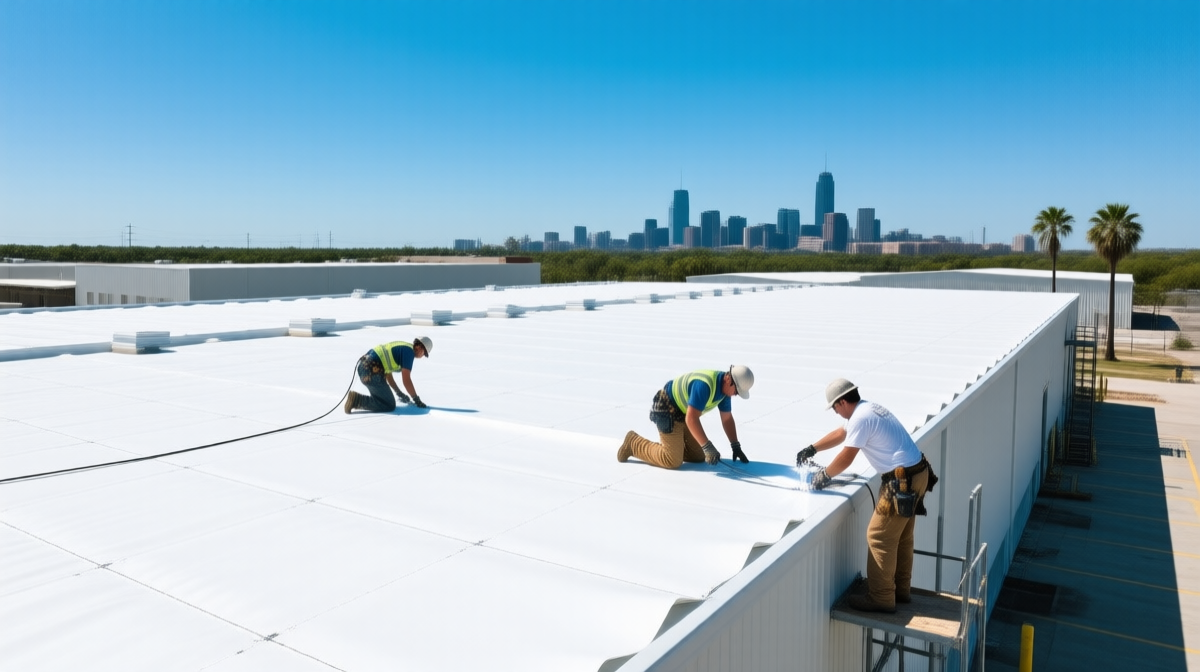
For facility managers and commercial property owners across San Antonio, selecting the right roofing system directly impacts operational costs, asset protection, and long-term ROI. TPO roofing in San Antonio has emerged as the dominant choice for low-slope commercial and industrial buildings — and for good reason. This single-ply membrane delivers the thermal performance, durability, and cost efficiency that South Texas buildings demand.
This article breaks down everything you need to know about TPO roofing for San Antonio commercial properties: how it performs under extreme heat, what it costs, and why it’s the smartest investment for warehouses, factories, retail centers, and office complexes across Bexar County.
Why TPO Roofing Dominates San Antonio’s Commercial Market
Thermoplastic Polyolefin (TPO) has become the fastest-growing commercial roofing membrane in North America over the past decade. According to industry data from Professional Roofing Magazine, TPO now accounts for more than 40% of new commercial low-slope installations nationally, and in hot climates like South Texas, that number climbs even higher [Source: Professional Roofing Magazine].
The reason is simple: TPO’s heat-welded seams create a monolithic, watertight barrier that resists the punishing San Antonio sun. Unlike EPDM, which absorbs heat, or modified bitumen, which can soften in extreme temperatures, TPO’s white reflective surface actively fights solar gain — a critical advantage when summer temperatures routinely exceed 100°F in the Alamo City.
Cool Roof Performance: Fighting San Antonio’s Heat
San Antonio averages 224 sunny days per year, making it one of the sunniest cities in the country. For a commercial building with a dark roof, surface temperatures can hit 170°F on a summer afternoon — driving air conditioning costs through the roof, literally.
White TPO membranes achieve an initial Solar Reflectance Index (SRI) of 100+ and an emissivity of 0.85 or higher, classifying them as “cool roofs” under ASHRAE 90.1 and the International Energy Conservation Code (IECC). The NRCA and its codes and standards division confirm that cool roof compliance is increasingly required for new commercial construction in climate zones like ours [Source: NRCA Codes and Standards].
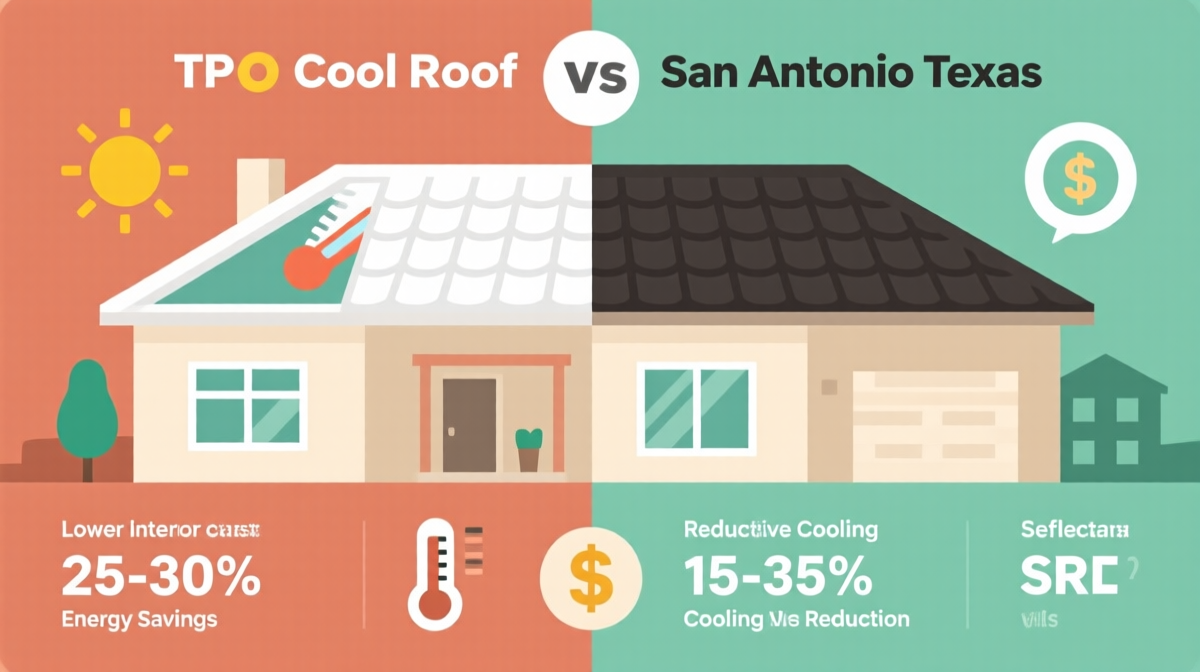
The results are measurable. Studies show that commercial buildings in South Texas with reflective TPO roofing reduce annual cooling energy consumption by 15–35%. For a 50,000-square-foot warehouse or distribution center near the I-35 corridor, that translates to $5,000–$12,000 in annual energy savings — every year, for the life of the roof.
Built for South Texas Weather
San Antonio’s weather doesn’t just test a roof’s thermal performance — it challenges its structural integrity year-round. The region experiences:
- Hail events: Bexar County sees an average of 2-3 significant hail storms annually, with stones that can puncture weaker membranes
- Flash flooding: Proper drainage and watertight seams are non-negotiable on flat commercial roofs
- UV degradation: 12+ hours of daily sunlight for 8 months of the year breaks down inferior materials
- Thermal shock: Rapid temperature swings during spring storms can crack rigid roofing systems
TPO’s heat-welded seams — not adhesives, not tapes — create a molecular bond that’s stronger than the membrane itself. This eliminates the seam failure points that plague EPDM roofs after 5-7 years of UV exposure. Modern TPO formulations also include advanced UV stabilizers and flame retardants that meet ASTM D6878 standards, ensuring 20+ year service life even under San Antonio’s intense sun.
TPO vs. Other Commercial Roofing Systems
When evaluating roofing options for San Antonio commercial properties, here’s how TPO stacks up against the alternatives:
| System | Typical Cost/SF (Installed) | Expected Lifespan | Energy Savings | Best For |
|---|---|---|---|---|
| TPO (60 mil) | $5.28 – $8.16 | 20–30 years | 15–35% | Warehouses, offices, retail |
| PVC (60 mil) | $6.50 – $9.50 | 20–30 years | 10–25% | Restaurants, food processing |
| EPDM (60 mil) | $4.50 – $7.00 | 15–20 years | 0–10% | Budget-sensitive projects |
| Standing Seam Metal | $10.00 – $18.00 | 30–50 years | 10–20% | High-end / historic buildings |
| Modified Bitumen | $5.00 – $8.00 | 10–15 years | 0–5% | High-traffic roof access |
Cost data reflects San Antonio market averages for 2026 [Source: Commercial Roof Guide San Antonio]
Restoration vs. Replacement: Making the Right Call
Not every aging commercial roof needs a full tear-off. TPO roof restoration — applying a fluid-applied silicone or acrylic coating over existing TPO — can extend service life by 10–15 years at roughly 40–60% of replacement cost. This is especially relevant for San Antonio property owners looking to defer major capital expenditure while improving energy performance.
However, restoration only works when the existing membrane is structurally sound. If you’re dealing with saturated insulation, corroded decking, or widespread seam failure, a full replacement with new TPO is the only option that protects your building long-term. A professional infrared moisture survey is the first step in making that call.
CPS Energy Incentives and ROI
San Antonio’s municipal utility, CPS Energy, offers incentive programs for commercial customers who implement energy-efficiency upgrades — including cool roof installations. Through CPS Energy’s Commercial Energy Efficiency programs, property owners can receive rebates for reflective roofing that reduces peak demand. When combined with federal tax deductions under Section 179D for energy-efficient commercial buildings, the payback period on a TPO roof replacement can shrink to 3–5 years.
For facility managers overseeing portfolios in the Stone Oak, Brooks City Base, or Westover Hills commercial districts, these incentives make TPO not just the best-performing choice, but the most financially sound one.
Choosing the Right TPO Contractor in San Antonio
Not all TPO installations are created equal. The membrane is only as good as the crew installing it. Look for contractors who:
- Are factory-authorized by major manufacturers (Elevate, GAF, Johns Manville, Carlisle)
- Hold current OSHA 30-hour safety certifications
- Provide 5-10 year workmanship warranties in addition to manufacturer material warranties
- Have verifiable experience with large-format TPO projects in South Texas
- Perform proper deck preparation, tapered insulation for drainage, and wind-uplift engineering per FM Global standards
Installation Best Practices for San Antonio Climate
Commercial Roofers San Antonio follows the rigorous installation protocols recommended by the NRCA’s Roofing Manual: Membrane Roof Systems. Key practices for South Texas installations include:
- Tapered polyiso insulation to ensure positive drainage toward roof drains — critical given San Antonio’s 30+ inches of annual rainfall and flash-flood potential
- Wind-uplift resistance designed for 110+ mph wind loads per Texas building codes
- Seam welding at 950–1050°F for optimal molecular bonding in ambient temperatures common to South Texas
- Expansion joint accommodation to handle thermal movement on large roof decks exposed to extreme solar gain
The Roofing Contractor industry report on the 2026 State of the Industry notes that 39% of commercial roofing contractors now offer integrated solar services, reflecting the growing demand for TPO roofs that can support rooftop photovoltaic systems [Source: Roofing Contractor 2026 State of the Industry Report]. A TPO roof installed today can be solar-ready for tomorrow — a future-proofing advantage for San Antonio businesses eyeing on-site renewable energy.
Frequently Asked Questions
How long does TPO roofing last in San Antonio’s climate?
With proper installation and regular maintenance, a 60-mil TPO membrane will last 20–30 years in San Antonio. UV stabilizers in modern TPO formulations resist degradation from the intense South Texas sun far better than earlier generations of single-ply roofing.
Does TPO roofing really lower air conditioning costs?
Yes. White TPO’s reflective surface reduces rooftop heat absorption by up to 80% compared to dark membranes or asphalt. For San Antonio commercial buildings, this translates to 15–35% lower cooling costs during the 8-month cooling season.
Is TPO or PVC better for commercial roofs in Texas?
Both perform well. TPO generally offers better value for standard warehouse, office, and retail applications. PVC is preferred where the roof is exposed to grease, chemicals, or animal fats — making it the better choice for restaurants and food processing facilities.
Can TPO be installed over an existing roof?
Yes — in many cases, TPO can be installed as a recover board over an existing single-ply membrane or modified bitumen roof, provided the existing system is dry and structurally sound. A full tear-off is required if the substrate is wet or deteriorated.
What maintenance does a TPO roof need?
Semi-annual inspections, debris removal, drain clearing, and seam spot-checking are recommended. After major hail or wind events — common in San Antonio — a professional inspection is advised to catch small punctures before they become leaks.
Ready to explore TPO roofing for your San Antonio commercial property? Contact Commercial Roofers San Antonio at (210) 555-0199 for a free roof assessment and detailed cost analysis. We serve all of Bexar County including Alamo Heights, Stone Oak, Brooks City Base, Westover Hills, and the I-35 industrial corridor.
Leave a Reply