Author: Commercial Roofer San Antonio

  • TPO Roofing in San Antonio: The Complete Guide for Commercial Property Owners (2026)

    TPO Roofing in San Antonio: The Complete Guide for Commercial Property Owners (2026)

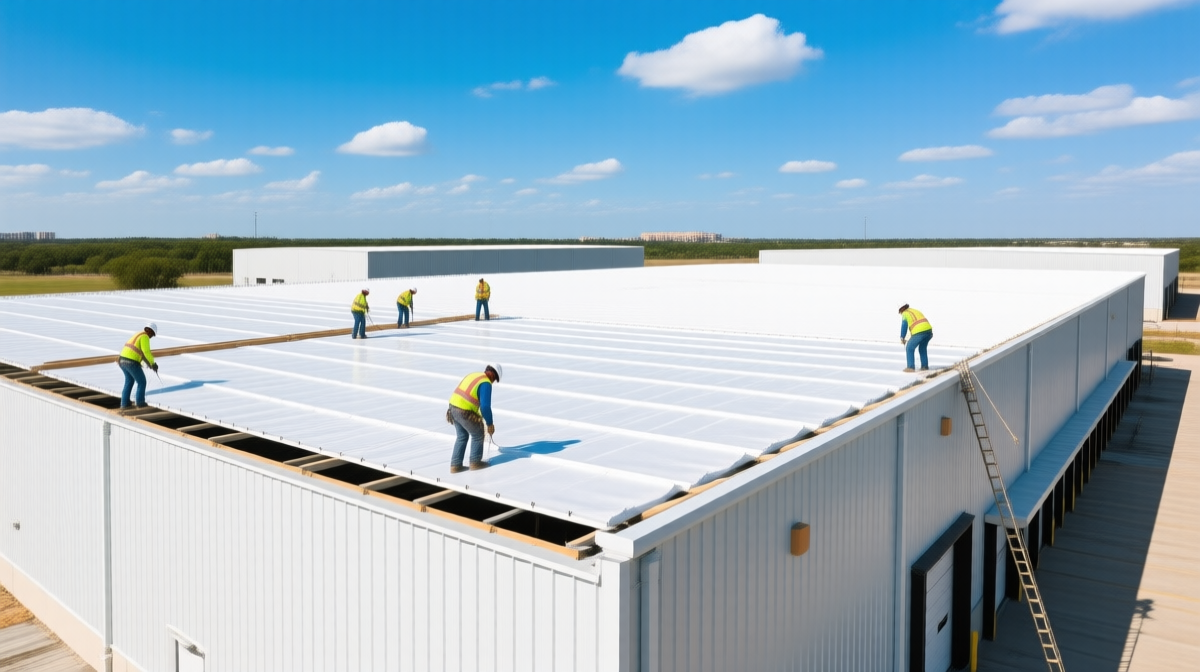
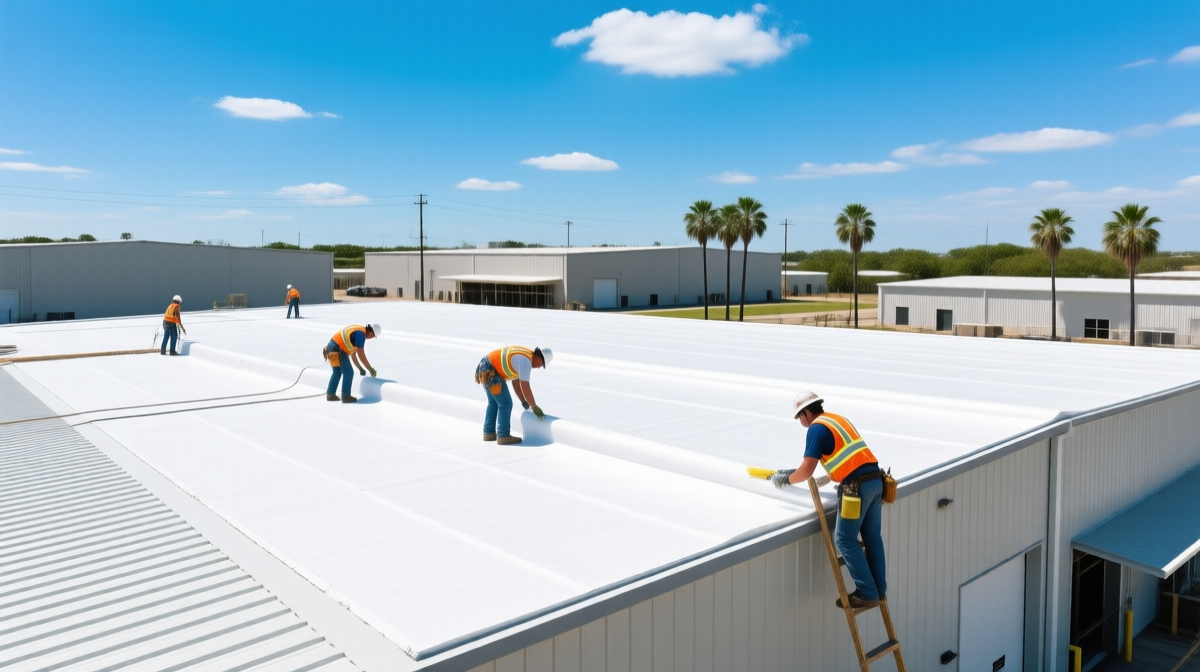
    Commercial roofing crew installing white TPO membrane on warehouse roof in San Antonio, Texas under bright sunshine

    For facility managers and commercial property owners across San Antonio, selecting the right roofing system directly impacts operational costs, asset protection, and long-term ROI. TPO roofing in San Antonio has emerged as the dominant choice for low-slope commercial and industrial buildings — and for good reason. This single-ply membrane delivers the thermal performance, durability, and cost efficiency that South Texas buildings demand.

    This article breaks down everything you need to know about TPO roofing for San Antonio commercial properties: how it performs under extreme heat, what it costs, and why it’s the smartest investment for warehouses, factories, retail centers, and office complexes across Bexar County.

    Why TPO Roofing Dominates San Antonio’s Commercial Market

    Thermoplastic Polyolefin (TPO) has become the fastest-growing commercial roofing membrane in North America over the past decade. According to industry data from Professional Roofing Magazine, TPO now accounts for more than 40% of new commercial low-slope installations nationally, and in hot climates like South Texas, that number climbs even higher [Source: Professional Roofing Magazine].

    The reason is simple: TPO’s heat-welded seams create a monolithic, watertight barrier that resists the punishing San Antonio sun. Unlike EPDM, which absorbs heat, or modified bitumen, which can soften in extreme temperatures, TPO’s white reflective surface actively fights solar gain — a critical advantage when summer temperatures routinely exceed 100°F in the Alamo City.

    Cool Roof Performance: Fighting San Antonio’s Heat

    San Antonio averages 224 sunny days per year, making it one of the sunniest cities in the country. For a commercial building with a dark roof, surface temperatures can hit 170°F on a summer afternoon — driving air conditioning costs through the roof, literally.

    White TPO membranes achieve an initial Solar Reflectance Index (SRI) of 100+ and an emissivity of 0.85 or higher, classifying them as “cool roofs” under ASHRAE 90.1 and the International Energy Conservation Code (IECC). The NRCA and its codes and standards division confirm that cool roof compliance is increasingly required for new commercial construction in climate zones like ours [Source: NRCA Codes and Standards].

    The results are measurable. Studies show that commercial buildings in South Texas with reflective TPO roofing reduce annual cooling energy consumption by 15–35%. For a 50,000-square-foot warehouse or distribution center near the I-35 corridor, that translates to $5,000–$12,000 in annual energy savings — every year, for the life of the roof.

    Built for South Texas Weather

    San Antonio’s weather doesn’t just test a roof’s thermal performance — it challenges its structural integrity year-round. The region experiences:

    • Hail events: Bexar County sees an average of 2-3 significant hail storms annually, with stones that can puncture weaker membranes
    • Flash flooding: Proper drainage and watertight seams are non-negotiable on flat commercial roofs
    • UV degradation: 12+ hours of daily sunlight for 8 months of the year breaks down inferior materials
    • Thermal shock: Rapid temperature swings during spring storms can crack rigid roofing systems

    TPO’s heat-welded seams — not adhesives, not tapes — create a molecular bond that’s stronger than the membrane itself. This eliminates the seam failure points that plague EPDM roofs after 5-7 years of UV exposure. Modern TPO formulations also include advanced UV stabilizers and flame retardants that meet ASTM D6878 standards, ensuring 20+ year service life even under San Antonio’s intense sun.

    TPO vs. Other Commercial Roofing Systems

    When evaluating roofing options for San Antonio commercial properties, here’s how TPO stacks up against the alternatives:

    System Typical Cost/SF (Installed) Expected Lifespan Energy Savings Best For
    TPO (60 mil) $5.28 – $8.16 20–30 years 15–35% Warehouses, offices, retail
    PVC (60 mil) $6.50 – $9.50 20–30 years 10–25% Restaurants, food processing
    EPDM (60 mil) $4.50 – $7.00 15–20 years 0–10% Budget-sensitive projects
    Standing Seam Metal $10.00 – $18.00 30–50 years 10–20% High-end / historic buildings
    Modified Bitumen $5.00 – $8.00 10–15 years 0–5% High-traffic roof access

    Cost data reflects San Antonio market averages for 2026 [Source: Commercial Roof Guide San Antonio]

    Restoration vs. Replacement: Making the Right Call

    Not every aging commercial roof needs a full tear-off. TPO roof restoration — applying a fluid-applied silicone or acrylic coating over existing TPO — can extend service life by 10–15 years at roughly 40–60% of replacement cost. This is especially relevant for San Antonio property owners looking to defer major capital expenditure while improving energy performance.

    However, restoration only works when the existing membrane is structurally sound. If you’re dealing with saturated insulation, corroded decking, or widespread seam failure, a full replacement with new TPO is the only option that protects your building long-term. A professional infrared moisture survey is the first step in making that call.

    CPS Energy Incentives and ROI

    San Antonio’s municipal utility, CPS Energy, offers incentive programs for commercial customers who implement energy-efficiency upgrades — including cool roof installations. Through CPS Energy’s Commercial Energy Efficiency programs, property owners can receive rebates for reflective roofing that reduces peak demand. When combined with federal tax deductions under Section 179D for energy-efficient commercial buildings, the payback period on a TPO roof replacement can shrink to 3–5 years.

    For facility managers overseeing portfolios in the Stone Oak, Brooks City Base, or Westover Hills commercial districts, these incentives make TPO not just the best-performing choice, but the most financially sound one.

    Choosing the Right TPO Contractor in San Antonio

    Not all TPO installations are created equal. The membrane is only as good as the crew installing it. Look for contractors who:

    • Are factory-authorized by major manufacturers (Elevate, GAF, Johns Manville, Carlisle)
    • Hold current OSHA 30-hour safety certifications
    • Provide 5-10 year workmanship warranties in addition to manufacturer material warranties
    • Have verifiable experience with large-format TPO projects in South Texas
    • Perform proper deck preparation, tapered insulation for drainage, and wind-uplift engineering per FM Global standards
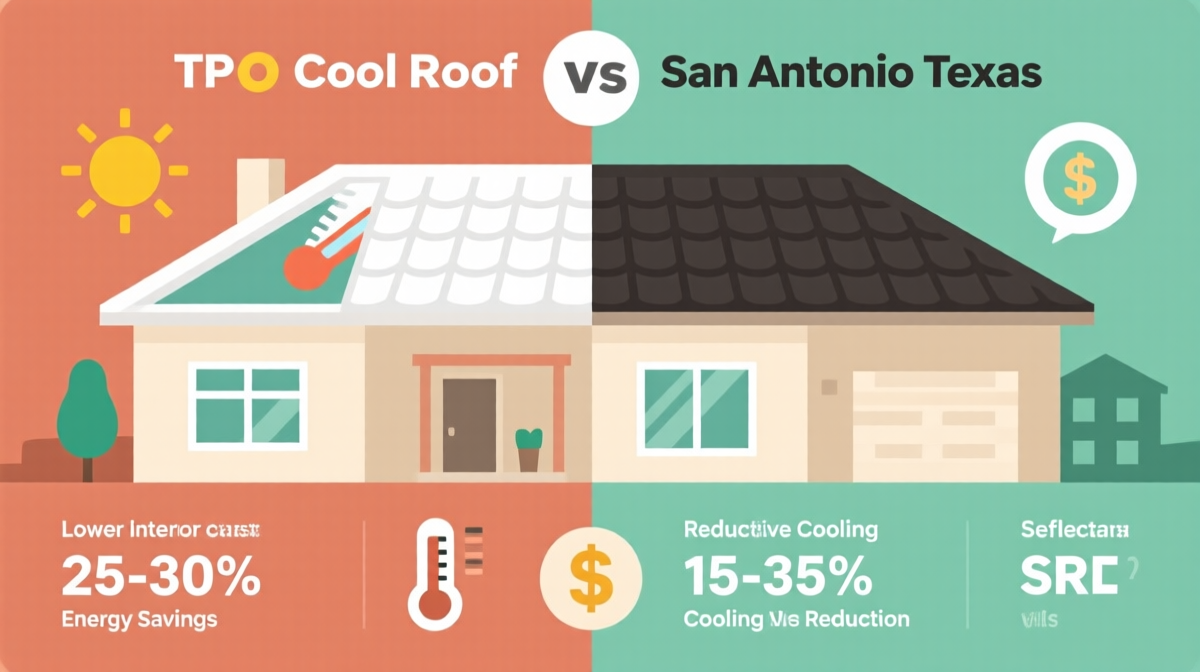
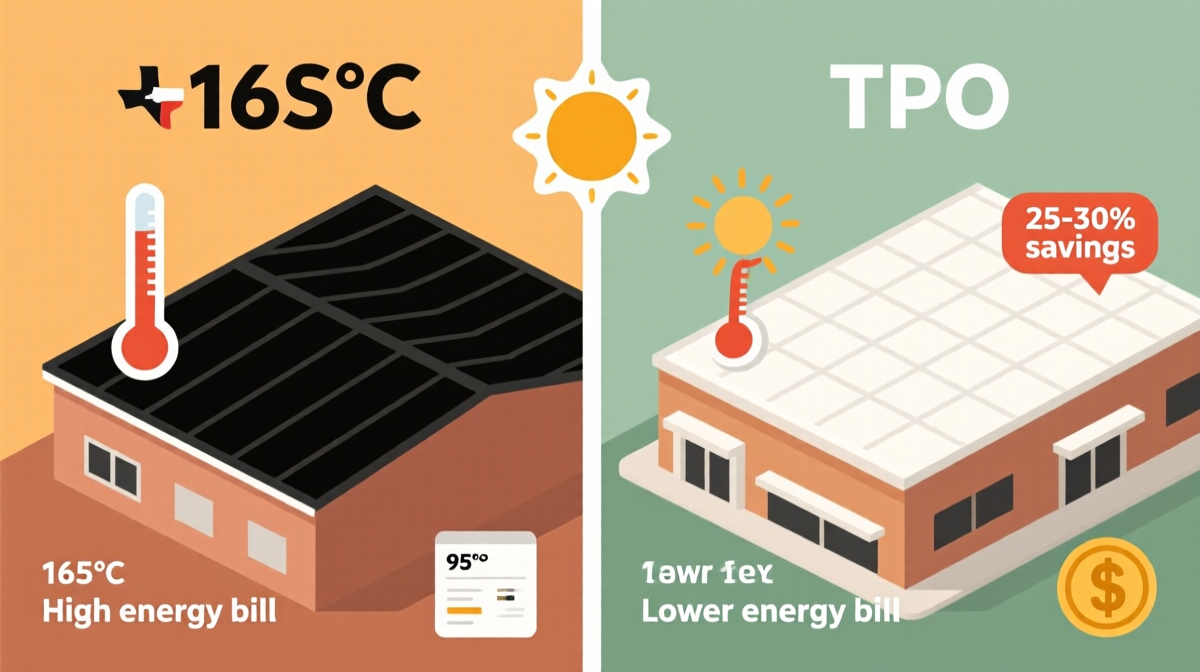
    Infographic showing energy savings comparison between TPO cool roof and dark roof for San Antonio commercial buildings

    Installation Best Practices for San Antonio Climate

    Commercial Roofers San Antonio follows the rigorous installation protocols recommended by the NRCA’s Roofing Manual: Membrane Roof Systems. Key practices for South Texas installations include:

    • Tapered polyiso insulation to ensure positive drainage toward roof drains — critical given San Antonio’s 30+ inches of annual rainfall and flash-flood potential
    • Wind-uplift resistance designed for 110+ mph wind loads per Texas building codes
    • Seam welding at 950–1050°F for optimal molecular bonding in ambient temperatures common to South Texas
    • Expansion joint accommodation to handle thermal movement on large roof decks exposed to extreme solar gain

    The Roofing Contractor industry report on the 2026 State of the Industry notes that 39% of commercial roofing contractors now offer integrated solar services, reflecting the growing demand for TPO roofs that can support rooftop photovoltaic systems [Source: Roofing Contractor 2026 State of the Industry Report]. A TPO roof installed today can be solar-ready for tomorrow — a future-proofing advantage for San Antonio businesses eyeing on-site renewable energy.

    Frequently Asked Questions

    How long does TPO roofing last in San Antonio’s climate?

    With proper installation and regular maintenance, a 60-mil TPO membrane will last 20–30 years in San Antonio. UV stabilizers in modern TPO formulations resist degradation from the intense South Texas sun far better than earlier generations of single-ply roofing.

    Does TPO roofing really lower air conditioning costs?

    Yes. White TPO’s reflective surface reduces rooftop heat absorption by up to 80% compared to dark membranes or asphalt. For San Antonio commercial buildings, this translates to 15–35% lower cooling costs during the 8-month cooling season.

    Is TPO or PVC better for commercial roofs in Texas?

    Both perform well. TPO generally offers better value for standard warehouse, office, and retail applications. PVC is preferred where the roof is exposed to grease, chemicals, or animal fats — making it the better choice for restaurants and food processing facilities.

    Can TPO be installed over an existing roof?

    Yes — in many cases, TPO can be installed as a recover board over an existing single-ply membrane or modified bitumen roof, provided the existing system is dry and structurally sound. A full tear-off is required if the substrate is wet or deteriorated.

    What maintenance does a TPO roof need?

    Semi-annual inspections, debris removal, drain clearing, and seam spot-checking are recommended. After major hail or wind events — common in San Antonio — a professional inspection is advised to catch small punctures before they become leaks.

    Ready to explore TPO roofing for your San Antonio commercial property? Contact Commercial Roofers San Antonio at (210) 555-0199 for a free roof assessment and detailed cost analysis. We serve all of Bexar County including Alamo Heights, Stone Oak, Brooks City Base, Westover Hills, and the I-35 industrial corridor.
  • Why TPO Roofing Is the Smartest Investment for San Antonio Commercial Buildings in 2026

    Why TPO Roofing Is the Smartest Investment for San Antonio Commercial Buildings in 2026

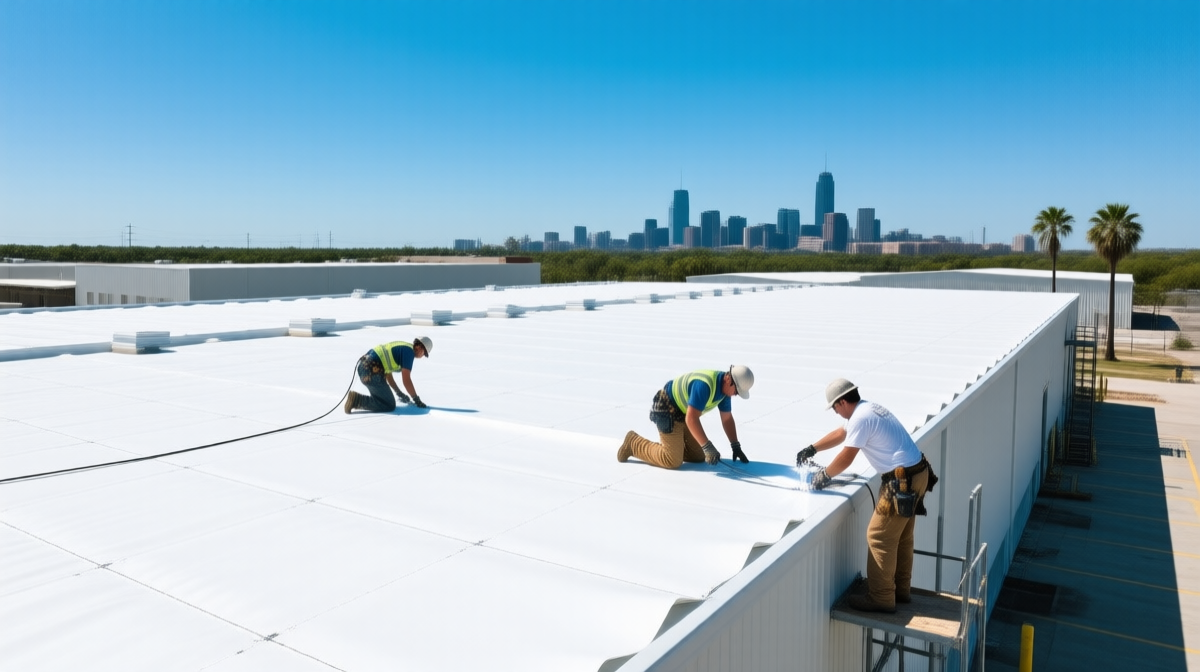
    Commercial TPO roofing installation on a warehouse in San Antonio, Texas — bright white membrane under South Texas sunshine

    For facility managers, property owners, and operations directors in San Antonio, selecting the right commercial roofing system is one of the most consequential capital decisions you’ll make. With more than 250 days of sunshine per year, blistering summer heat indexes exceeding 105°F, and increasingly stringent energy codes, TPO roofing has emerged as the dominant solution for flat and low-slope commercial buildings across the Alamo City.

    Thermoplastic Polyolefin (TPO) now commands over 35% of the commercial low-slope roofing market in North America — and for good reason. Its heat-welded seams, reflective membrane surface, and cost-effective installation make it particularly well-suited for the San Antonio climate. But not all TPO systems are equal, and understanding the nuances can mean the difference between a roof that performs for 25+ years and one that requires premature replacement.

    Why TPO Outperforms Other Membranes in South Texas

    TPO roofing membranes are single-ply systems made from a blend of polypropylene and ethylene-propylene rubber. The material is manufactured in wide sheets, heat-welded at the seams to create a monolithic, watertight barrier. This seam strength is critical in San Antonio, where buildings face both extreme UV exposure and sudden, heavy thunderstorms.

    According to Professional Roofing Magazine, cold roof condensation design flaws are the most commonly observed and easily avoided problem on low-slope roofs today [Source: Professional Roofing Magazine, “The Trouble I Have Seen,” April 2026]. In San Antonio’s humid subtropical climate, where summer dew points regularly reach the 70s, vapor drive through roof decks can lead to moisture accumulation under improperly designed TPO systems. That’s why proper insulation placement — not just membrane selection — determines long-term performance.

    Compared to PVC, TPO offers better cost efficiency and comparable seam strength. Compared to EPDM (black rubber), TPO’s white reflective surface delivers drastically lower rooftop temperatures, directly reducing cooling loads for air-conditioned commercial buildings.

    Energy Savings: The CPS Energy Advantage

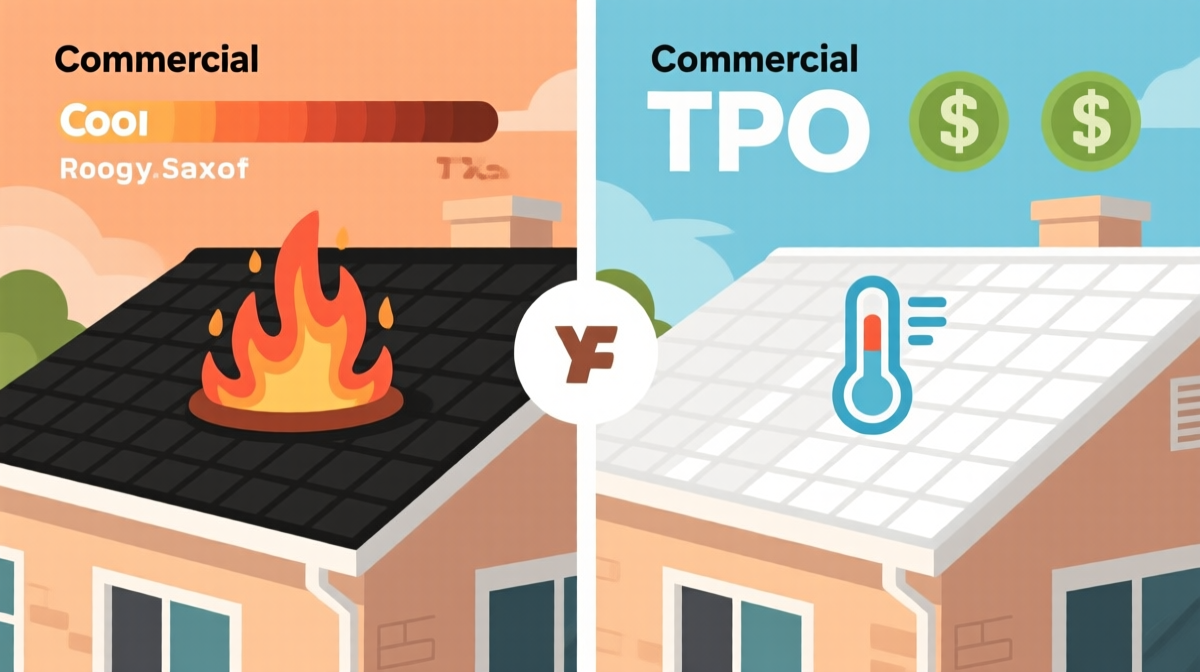
    Infographic comparing energy costs between dark roof and cool white TPO roof for commercial buildings in San Antonio, Texas — showing 25-30% cooling savings

    San Antonio’s CPS Energy offers commercial rebate programs for properties that install cool roof systems with high solar reflectance. White TPO membranes typically achieve an initial solar reflectance of 0.80 or higher and an thermal emittance above 0.75 — qualifying them as ENERGY STAR® rated and compliant with the 2021 International Energy Conservation Code (IECC) as adopted by the City of San Antonio.

    RoofersCoffeeShop reports that TPO went from virtually zero market share in the early 2000s to a dominant position today, driven primarily by its energy-saving properties for large commercial buildings in sun-soaked regions like Texas [Source: RoofersCoffeeShop, “Understanding the Rise of TPO in Roofing,” April 2025]. Facilities in climate zones similar to San Antonio with reflective TPO roofing typically reduce cooling costs by 25–30% compared to buildings with dark asphalt or EPDM roofs.

    For a 50,000-square-foot warehouse in the Northeast Industrial District or Westover Hills, that translates to an estimated $8,000–$12,000 in annual HVAC savings — money that goes straight to your bottom line.

    Durability & Hail Resistance for South Texas Weather

    San Antonio sits in a corridor that experiences hailstorms capable of damaging roof membranes. TPO has evolved significantly since its early formulations. Modern TPO membranes from manufacturers like Elevate (formerly Firestone), GAF, Carlisle, and Duro-Last include reinforced scrim layers that improve puncture resistance and dimensional stability.

    FM Global’s latest wind uplift classifications rate properly installed mechanically attached and fully adhered TPO systems for wind speeds exceeding 150 mph — well above San Antonio’s design wind speeds as defined in the current building code (IRC 2021, Chapter 10). For factory and warehouse owners concerned about production downtime during storm season, TPO’s heat-welded seams eliminate the failure points common with adhesive-only systems.

    San Antonio Building Code Compliance

    The City of San Antonio adopted updated building codes effective May 1, 2025, with Chapter 10 addressing building-related regulations including energy compliance for commercial structures. As outlined in Information Bulletin IB-221, commercial buildings must meet minimum insulation R-values and cool roof reflectance requirements. White TPO roofs inherently satisfy these provisions without additional coatings or treatments.

    Facilities in the I-35 Corridor, Brooks City Base, and Schertz/Cibolo warehousing districts should verify that their roofing contractor understands local amendments to the 2021 IECC, particularly the cool roof provisions for buildings with >50% roof replacement scope.

    Restoration vs. Replacement: When TPO Makes Sense

    Not every San Antonio commercial building needs a full TPO replacement. Silicone restoration coatings can extend the life of existing built-up roofs (BUR) and modified bitumen systems by 10–15 years. However, when the existing membrane shows widespread alligatoring, moisture saturation in the insulation, or repetitive leak history, a complete tear-off and TPO installation is the more cost-effective long-term solution.

    The rule of thumb for facility directors: if your roof has required three or more service calls in the last two years, or if thermal imaging shows wet insulation covering more than 15% of the deck area, replacement — not repair — is the appropriate capital strategy.

    Frequently Asked Questions

    How long does a TPO roof last in San Antonio’s climate?

    A properly installed TPO roof in San Antonio can last 20–25 years before requiring replacement. The key factors are seam weld quality, membrane thickness (60–80 mil recommended for commercial), and annual maintenance that includes cleaning debris and inspecting flashings.

    Does TPO roofing reduce building cooling costs in Texas?

    Yes. White TPO membranes reflect up to 85% of solar radiation, reducing rooftop surface temperatures by 60–80°F compared to black roofs. This translates to 25–30% lower cooling costs for air-conditioned commercial buildings in San Antonio.

    Is TPO roofing hail resistant?

    Modern reinforced TPO membranes can withstand moderate hail (up to 1.5–2 inches) without puncturing. For facilities in high-hail-risk areas of Bexar County, upgrading to a 60-mil reinforced TPO membrane with an additional cover board provides enhanced impact resistance.

    What is the difference between TPO and PVC roofing?

    Both are single-ply membranes with heat-welded seams, but TPO is typically more cost-effective (10–20% less material cost) while PVC offers superior chemical resistance for restaurants or industrial kitchens. For general warehouse and office buildings in San Antonio, TPO offers the best value.

    Does CPS Energy offer rebates for TPO roofing?

    Yes. CPS Energy’s Commercial Energy Efficiency Program provides incentives for cool roof installations that meet reflectivity and emissivity standards. A typical 50,000-square-foot warehouse may qualify for $5,000–$10,000 in rebates depending on the project scope and energy model results.

    Schedule Your San Antonio Commercial Roof Assessment

    Whether you manage a manufacturing facility, warehouse, retail center, or office building, understanding your roof’s condition and your options is the first step toward protecting your asset. Get a same-week inspection with a 27-point report, drone survey, and honest guidance on repair vs. replacement. Contact Commercial Roofers San Antonio today.

  • Cool Roofs & TPO Roofing in San Antonio: 2026 Energy Codes, CPS Incentives & Hail Protection

    Cool Roofs & TPO Roofing in San Antonio: 2026 Energy Codes, CPS Incentives & Hail Protection


    Why San Antonio Commercial Property Owners Are Switching to Cool Roofs in 2026

    San Antonio’s commercial property owners and facility managers face a unique combination of climate challenges: prolonged triple-digit summer heat, intense UV radiation, hailstorms between March and June, and increasingly strict energy codes. The commercial roofing system you choose directly impacts your bottom line — from cooling costs to equipment lifespan. In 2026, cool roofing systems — particularly TPO (thermoplastic polyolefin) membranes — have become the go-to solution for factories, warehouses, and commercial buildings across the Alamo City.

    What Makes a Roof “Cool” for South Texas?

    A cool roof is designed to reflect more sunlight and absorb less heat than a standard roof. Measured by two key metrics — solar reflectance (the ability to reflect sunlight) and thermal emittance (the ability to radiate absorbed heat) — cool roof membranes like white TPO can stay up to 50°F cooler in direct sun compared to dark-colored BUR (built-up roofing) or modified bitumen systems.

    For San Antonio, which sits in IECC Climate Zone 2 (hot-humid), this is a game-changer. According to NRCA’s July/August 2026 EnergyWise update, the latest 2024 IECC and 2022 ASHRAE 90.1 standards include updated climate zone data for more than 2,700 U.S. weather stations, refining R-value minimums and energy cost estimates for commercial roof assemblies. [Source: Professional Roofing Magazine, “EnergyWise update,” July/August 2026]

    TPO Roofing: The Dominant Choice for San Antonio Warehouses and Factories

    TPO single-ply roofing has become the dominant membrane for low-slope commercial roofs in San Antonio — and for good reason. With 60-mil and 80-mil options, heat-welded seams, and highly reflective white surfaces, TPO delivers:

    • Energy savings: White TPO membranes reflect 80%+ of solar radiation, reducing warehouse cooling loads by 15–30% during San Antonio’s sweltering summer months.
    • Heat-welded seam strength: Seams are fused with hot air, creating bonds stronger than the membrane itself — critical for resisting wind uplift during the severe thunderstorms common along the I-35 corridor.
    • Chemical resistance: Industrial facilities near the Northeast Industrial District and Brooks City Base benefit from TPO’s resistance to oils, grease, and chemical exposure.
    • Cost-effectiveness: Current San Antonio installation costs for 60-mil TPO range from $5.28 to $8.16 per square foot, making it the most cost-competitive premium single-ply option. [Source: Commercial Roof Guide, 2026]

    Infographic comparing energy costs between dark traditional roof and reflective white TPO cool roof for commercial buildings in San Antonio climate

    How San Antonio’s Building Codes Drive Cool Roof Adoption

    San Antonio has adopted the 2021 International Energy Conservation Code (IECC) with local amendments. For commercial low-slope roofs (slope ≤ 2:12) over cooled spaces in Climate Zone 2, the code requires:

    • A minimum aged solar reflectance of 0.55 and thermal emittance of 0.75 (or a minimum SRI of 64), OR
    • Insulation achieving a minimum of R-15 continuous above the deck.

    White TPO membranes with polyisocyanurate insulation easily meet these thresholds. NRCA’s EnergyWise Roof Calculator — recently updated with the 2024 IECC and 2022 ASHRAE 90.1 parameters — allows San Antonio building designers to model exact R-values and energy cost projections for their specific facility and location. [Source: Professional Roofing Magazine, “EnergyWise update,” July/August 2026]

    CPS Energy Incentives and ROI for Commercial Cool Roofs

    CPS Energy, San Antonio’s municipal utility, has historically offered rebates and incentives through its STEP (Save for Tomorrow Energy Plan) program for commercial energy-efficiency upgrades, including cool roof installations. While specific rebate amounts fluctuate by fiscal year, installing a reflective TPO or PVC roof typically qualifies for commercial energy-efficiency incentives when paired with increased insulation R-values.

    For a 50,000-square-foot warehouse in the Westover Hills industrial district, switching from a dark BUR roof to a white TPO cool roof can save an estimated $8,000–$15,000 annually in cooling costs alone — before factoring in insulation upgrades and CPS Energy incentives. Many San Antonio property owners see full ROI within 3–5 years.

    Hail and Storm Resilience: A San Antonio Priority

    San Antonio averages hail reports exceeding 1-inch diameter every spring, with the most recent 1.50-inch ping-pong-sized hail recorded on March 31, 2025. Hail, wind, and flash flooding account for 89% of commercial roof damage claims in Bexar County. [Source: Stormersite Hail Reports; Affordable Roofing Contractors San Antonio, 2026]

    For commercial property owners, impact-resistant TPO and PVC membranes (tested to FM 4470 and UL 2218 Class 4 standards) provide superior protection. TPO’s flexibility allows it to absorb minor impacts without cracking, unlike modified bitumen or built-up roofing that can granulate and degrade under repeated hailstrikes. Standing seam metal roofing is another excellent option for factories and warehouses in high-hail zones, offering Class 4 impact ratings and 40+ year service lives.

    PVC vs. TPO vs. Metal: Which Cool Roof Is Right for Your San Antonio Facility?

    System Cool Roof Rating Best For Cost Range (Installed / sq. ft.)
    TPO (60-mil) Excellent Warehouses, distribution centers, retail $5.28–$8.16
    PVC (60-mil) Excellent Food processing, chemical plants, kitchens $7.00–$10.00
    Standing Seam Metal Good (with cool coating) Factories, big-box retail, aircraft hangars $10.00–$18.00
    Silicone Restoration Coating Very Good Existing BUR or modified bitumen roofs $3.00–$6.00

    Why Work With a San Antonio Commercial Roofing Specialist

    Installing a cool roof isn’t just about slapping down white membrane. Proper installation requires:

    • Correct tapered insulation design for positive drainage (per NRCA guidelines)
    • Heat-welded seam integrity testing
    • Wind uplift resistance compliance (especially critical for San Antonio’s storm season)
    • Coordination with CPS Energy incentive paperwork
    • Compliance with San Antonio’s adopted IECC 2021 commercial energy code

    Whether your facility is near Loop 410, in the Port San Antonio industrial park, or along the growing I-35 manufacturing corridor, a local commercial roofing contractor with deep knowledge of South Texas climate conditions and local codes is essential.

    Frequently Asked Questions

    How much does a commercial TPO roof cost in San Antonio in 2026?

    San Antonio TPO roof installation typically ranges from $5.28 to $8.16 per square foot for 60-mil membrane on a low-slope commercial roof, depending on insulation requirements, roof complexity, and whether it’s a new install or a tear-off replacement.

    Does CPS Energy offer rebates for commercial cool roofs?

    Yes. CPS Energy’s STEP program has historically offered incentives for commercial energy-efficiency measures, including cool roof installations. Specific rebate amounts vary by fiscal year and project scope. Your contractor can help identify current incentives.

    How long does a TPO commercial roof last in South Texas?

    A properly installed 60-mil or 80-mil TPO roof in San Antonio’s climate typically lasts 20–25 years. White membranes may require cleaning every 3–5 years to maintain full reflectivity, and annual inspections are recommended after hail season (March–June).

    What’s better for a San Antonio factory: TPO or metal roofing?

    Both are excellent. TPO offers lower upfront cost and superior energy reflectivity. Standing seam metal offers greater impact resistance and a longer lifespan (40+ years) at a higher initial investment. The best choice depends on your budget, hail exposure, and long-term facility plans.

    Can I install a cool roof coating over my existing built-up roof?

    Yes. Silicone and acrylic restoration coatings can be applied over existing BUR or modified bitumen roofs, provided the underlying roof is structurally sound. This approach typically costs $3–$6 per square foot and can extend roof life by 10–15 years while improving energy performance — often qualifying for CPS Energy incentives.