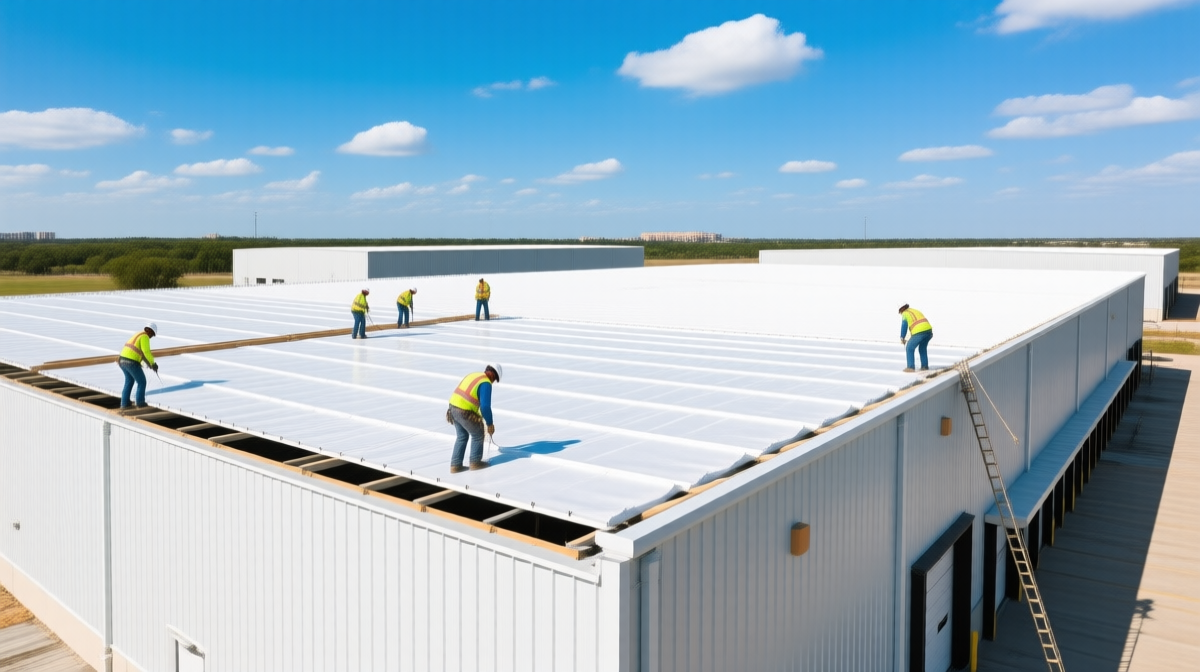
Why San Antonio Commercial Property Owners Are Switching to Cool Roofs in 2026
San Antonio’s commercial property owners and facility managers face a unique combination of climate challenges: prolonged triple-digit summer heat, intense UV radiation, hailstorms between March and June, and increasingly strict energy codes. The commercial roofing system you choose directly impacts your bottom line — from cooling costs to equipment lifespan. In 2026, cool roofing systems — particularly TPO (thermoplastic polyolefin) membranes — have become the go-to solution for factories, warehouses, and commercial buildings across the Alamo City.
What Makes a Roof “Cool” for South Texas?
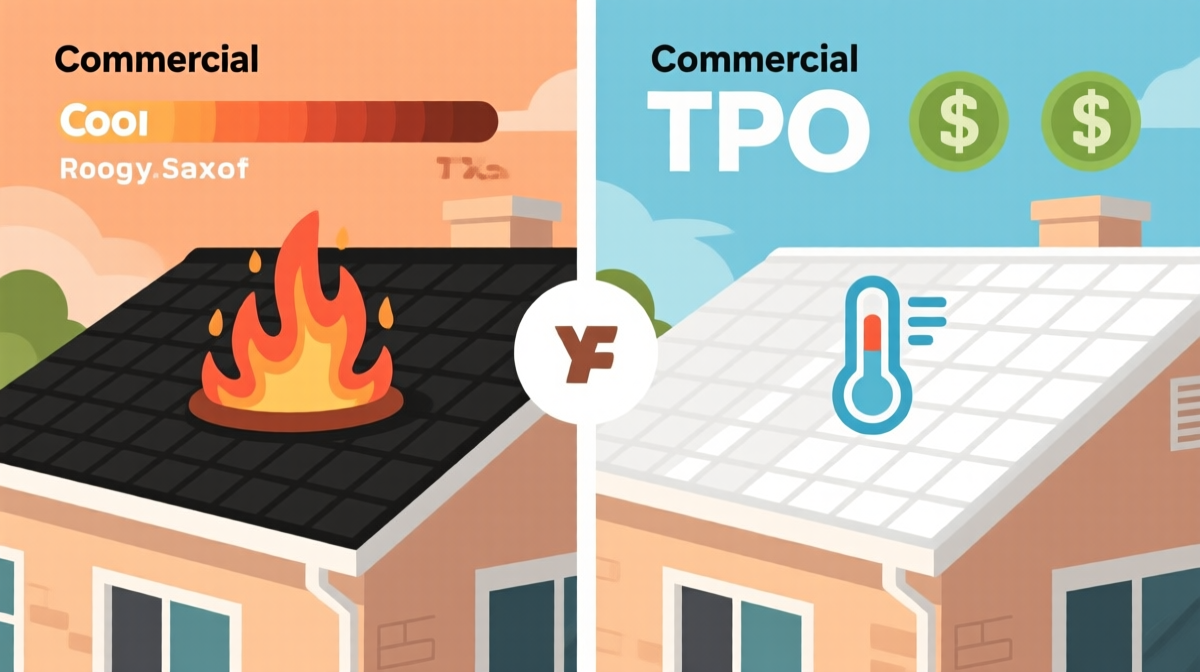
A cool roof is designed to reflect more sunlight and absorb less heat than a standard roof. Measured by two key metrics — solar reflectance (the ability to reflect sunlight) and thermal emittance (the ability to radiate absorbed heat) — cool roof membranes like white TPO can stay up to 50°F cooler in direct sun compared to dark-colored BUR (built-up roofing) or modified bitumen systems.
For San Antonio, which sits in IECC Climate Zone 2 (hot-humid), this is a game-changer. According to NRCA’s July/August 2026 EnergyWise update, the latest 2024 IECC and 2022 ASHRAE 90.1 standards include updated climate zone data for more than 2,700 U.S. weather stations, refining R-value minimums and energy cost estimates for commercial roof assemblies. [Source: Professional Roofing Magazine, “EnergyWise update,” July/August 2026]
TPO Roofing: The Dominant Choice for San Antonio Warehouses and Factories
TPO single-ply roofing has become the dominant membrane for low-slope commercial roofs in San Antonio — and for good reason. With 60-mil and 80-mil options, heat-welded seams, and highly reflective white surfaces, TPO delivers:
- Energy savings: White TPO membranes reflect 80%+ of solar radiation, reducing warehouse cooling loads by 15–30% during San Antonio’s sweltering summer months.
- Heat-welded seam strength: Seams are fused with hot air, creating bonds stronger than the membrane itself — critical for resisting wind uplift during the severe thunderstorms common along the I-35 corridor.
- Chemical resistance: Industrial facilities near the Northeast Industrial District and Brooks City Base benefit from TPO’s resistance to oils, grease, and chemical exposure.
- Cost-effectiveness: Current San Antonio installation costs for 60-mil TPO range from $5.28 to $8.16 per square foot, making it the most cost-competitive premium single-ply option. [Source: Commercial Roof Guide, 2026]
How San Antonio’s Building Codes Drive Cool Roof Adoption
San Antonio has adopted the 2021 International Energy Conservation Code (IECC) with local amendments. For commercial low-slope roofs (slope ≤ 2:12) over cooled spaces in Climate Zone 2, the code requires:
- A minimum aged solar reflectance of 0.55 and thermal emittance of 0.75 (or a minimum SRI of 64), OR
- Insulation achieving a minimum of R-15 continuous above the deck.
White TPO membranes with polyisocyanurate insulation easily meet these thresholds. NRCA’s EnergyWise Roof Calculator — recently updated with the 2024 IECC and 2022 ASHRAE 90.1 parameters — allows San Antonio building designers to model exact R-values and energy cost projections for their specific facility and location. [Source: Professional Roofing Magazine, “EnergyWise update,” July/August 2026]
CPS Energy Incentives and ROI for Commercial Cool Roofs
CPS Energy, San Antonio’s municipal utility, has historically offered rebates and incentives through its STEP (Save for Tomorrow Energy Plan) program for commercial energy-efficiency upgrades, including cool roof installations. While specific rebate amounts fluctuate by fiscal year, installing a reflective TPO or PVC roof typically qualifies for commercial energy-efficiency incentives when paired with increased insulation R-values.
For a 50,000-square-foot warehouse in the Westover Hills industrial district, switching from a dark BUR roof to a white TPO cool roof can save an estimated $8,000–$15,000 annually in cooling costs alone — before factoring in insulation upgrades and CPS Energy incentives. Many San Antonio property owners see full ROI within 3–5 years.
Hail and Storm Resilience: A San Antonio Priority
San Antonio averages hail reports exceeding 1-inch diameter every spring, with the most recent 1.50-inch ping-pong-sized hail recorded on March 31, 2025. Hail, wind, and flash flooding account for 89% of commercial roof damage claims in Bexar County. [Source: Stormersite Hail Reports; Affordable Roofing Contractors San Antonio, 2026]
For commercial property owners, impact-resistant TPO and PVC membranes (tested to FM 4470 and UL 2218 Class 4 standards) provide superior protection. TPO’s flexibility allows it to absorb minor impacts without cracking, unlike modified bitumen or built-up roofing that can granulate and degrade under repeated hailstrikes. Standing seam metal roofing is another excellent option for factories and warehouses in high-hail zones, offering Class 4 impact ratings and 40+ year service lives.
PVC vs. TPO vs. Metal: Which Cool Roof Is Right for Your San Antonio Facility?
| System | Cool Roof Rating | Best For | Cost Range (Installed / sq. ft.) |
|---|---|---|---|
| TPO (60-mil) | Excellent | Warehouses, distribution centers, retail | $5.28–$8.16 |
| PVC (60-mil) | Excellent | Food processing, chemical plants, kitchens | $7.00–$10.00 |
| Standing Seam Metal | Good (with cool coating) | Factories, big-box retail, aircraft hangars | $10.00–$18.00 |
| Silicone Restoration Coating | Very Good | Existing BUR or modified bitumen roofs | $3.00–$6.00 |
Why Work With a San Antonio Commercial Roofing Specialist
Installing a cool roof isn’t just about slapping down white membrane. Proper installation requires:
- Correct tapered insulation design for positive drainage (per NRCA guidelines)
- Heat-welded seam integrity testing
- Wind uplift resistance compliance (especially critical for San Antonio’s storm season)
- Coordination with CPS Energy incentive paperwork
- Compliance with San Antonio’s adopted IECC 2021 commercial energy code
Whether your facility is near Loop 410, in the Port San Antonio industrial park, or along the growing I-35 manufacturing corridor, a local commercial roofing contractor with deep knowledge of South Texas climate conditions and local codes is essential.
Frequently Asked Questions
How much does a commercial TPO roof cost in San Antonio in 2026?
San Antonio TPO roof installation typically ranges from $5.28 to $8.16 per square foot for 60-mil membrane on a low-slope commercial roof, depending on insulation requirements, roof complexity, and whether it’s a new install or a tear-off replacement.
Does CPS Energy offer rebates for commercial cool roofs?
Yes. CPS Energy’s STEP program has historically offered incentives for commercial energy-efficiency measures, including cool roof installations. Specific rebate amounts vary by fiscal year and project scope. Your contractor can help identify current incentives.
How long does a TPO commercial roof last in South Texas?
A properly installed 60-mil or 80-mil TPO roof in San Antonio’s climate typically lasts 20–25 years. White membranes may require cleaning every 3–5 years to maintain full reflectivity, and annual inspections are recommended after hail season (March–June).
What’s better for a San Antonio factory: TPO or metal roofing?
Both are excellent. TPO offers lower upfront cost and superior energy reflectivity. Standing seam metal offers greater impact resistance and a longer lifespan (40+ years) at a higher initial investment. The best choice depends on your budget, hail exposure, and long-term facility plans.
Can I install a cool roof coating over my existing built-up roof?
Yes. Silicone and acrylic restoration coatings can be applied over existing BUR or modified bitumen roofs, provided the underlying roof is structurally sound. This approach typically costs $3–$6 per square foot and can extend roof life by 10–15 years while improving energy performance — often qualifying for CPS Energy incentives.
Leave a Reply